Why do so many talented fundraisers struggle with major gift work?
Kent Stroman, author of the book “Asking about Asking” interviewed 594 fundraising professionals and identified the top 34 obstacles that consistently block success. Have you felt the “difficulty of getting in” or “fear” to “lack of confidence” and perhaps even the “absence of a plan?”
When you see them all listed out, it can feel overwhelming.
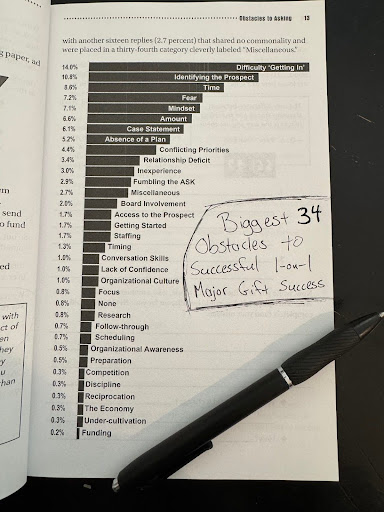
Roadblocks like these are often an excuse to handle something else, and the “something else” in nonprofits is often highly urgent.
I get it. I grew up in a family business where everything was “urgent.” I even remember explaining the Eisenhower Matrix to my dad at age 19—a simple exercise that helps you separate “urgent” from “important.” He paused for a moment, looked at me, and then walked off to handle the next emergency with the words: “It’s all urgent.”
Nonprofit fundraising often feels that way. For more than a decade, I’ve heard the same refrain from hundreds of executive directors: “We know we should be building deeper relationships, but there’s just no time.”
Here’s the good news: You don’t need to solve 34 problems at once. You just need a simple framework. Just one daily action that shifts you out of the “everything is urgent” treadmill and into consistent, relational cultivation. Over time, those 34 roadblocks shrink from immovable barriers to small speed bumps on the road to major gift success.
The Framework: How to Overcome the 34 Obstacles
The natural temptation when you see a list of 34 obstacles is to think, “I need 34 different strategies to solve all of these.” But that kind of thinking only reinforces the overwhelm. The truth is, you don’t need 34 solutions. You just need one clear framework that makes the obstacles manageable.
Here it is:
Take one personal action every workday to make someone feel like a hero to your organization.
That’s it. One intentional step, every day. It might sound simple, but the cumulative impact is transformational.
What counts as an “Action”?
- A phone call
- A personal text
- A face-to-face visit
- A meaningful conversation
Who counts as “Someone”?
- A current or past donor
- A volunteer
- An adoptive family you’ve served
- A foundation representative
- Anyone whose life has intersected with your mission
What does it mean to make them a “Hero”?
It’s about helping them see, feel, or participate in the positive work your organization is doing. Maybe it’s as simple as saying, “Because of you, three new families have safe housing this month.” Or inviting them to tour your facility and see the impact firsthand.
This framework works because it shifts you from transactional fundraising (asks, reports, repeat) to relational cultivation (gratitude, connection, shared mission). It’s a daily habit that chips away at fear, busyness, and lack of confidence without requiring a complicated plan.
Instead of trying to conquer 34 obstacles, you sidestep them by creating momentum. Over time, the very things that once felt like barriers shrink into manageable speed bumps.
Practical Application: Building Your Top 100 List
A framework is only powerful if you put it into action. The simplest way to start is by building and working from your Top 100 List. This is a curated group of the most important relationships your organization should be cultivating this year.
Step 1: Identify Your Top 100
Pull together a list of your most vital supporters. This might include:
- Longtime donors who already give generously
- Emerging donors with clear potential
- Volunteers deeply invested in your mission
- Foundation or corporate partners
- Families or individuals whose lives have been impacted by your work
This is not just a list of the wealthiest names. Instead, it’s a mix of those who care deeply and those who could expand their impact with the right cultivation.
Step 2: Commit to Daily Stewardship
With your list in hand, commit to one personal action every workday. By keeping the discipline small, it stays achievable even during the busiest seasons.
Think about the math: there are roughly 250 workdays in a year. That means each of the 100 names on your list can expect at least two personal, meaningful touchpoints from you annually.
Step 3: Lead With Gratitude
The best place to begin is a simple “thank you.” Express appreciation without an ask attached. A quick call, handwritten note, or text saying, “You made this possible,” goes further than you think. Gratitude sets the foundation for a deeper connection.
Step 4: Make It Human
Don’t overcomplicate it. One day might be a 5-minute call. Another day might be inviting a supporter to visit your site. The goal is consistency. Each small act communicates: “You matter. You are part of this mission.”
Step 5: Track Your Actions
Use a simple CRM, spreadsheet, or even a notebook to keep track of who you’ve reached out to and how. The act of tracking ensures no one gets lost in the shuffle and helps you celebrate the progress you’re making.
Following these steps helps you replace the pressure of “I should be doing more” with a concrete plan. Over time, this turns your Top 100 from a static list into a vibrant circle of engaged champions for your mission.
The Long-Term Payoff
As you first start this daily discipline, the impact might feel small. One call. One text. One thank-you note. But like compound interest, the results build over time, and the payoff is transformational.
Immediate Benefits
Within weeks, you’ll notice your supporters responding differently. A handwritten note gets a heartfelt reply. A VIP donor who hasn’t given in two years picks up the phone and says, “I was just thinking about your work.” Volunteers feel more connected. Foundation partners feel more valued. Small, intentional actions create a ripple of goodwill.
Mid-Term Outcomes
Over the course of a year, your Top 100 relationships will each have at least two personal touchpoints. That level of consistent care deepens trust, strengthens loyalty, and opens doors for bigger conversations. Donors begin to see themselves as part of your mission, not just as dollar signs.
Long-Term Transformation
Year after year, the shift compounds. Relationships that once felt transactional become relational. Instead of scrambling to overcome 34 separate obstacles, you’ll find most of them have quietly faded into the background.
This is the real secret to major gift fundraising: it’s not about mastering 34 tactics. It’s about building a rhythm of daily actions that transform your donor community over time.
Ready to Build Stronger Donor Relationships?
So here’s the challenge: start today. Make one call. Send one text. Write one thank-you note. Begin your own gratitude campaign, and watch how it reshapes both your donor relationships and your organization’s future.
If you’re ready to move beyond the “everything is urgent” treadmill and build a sustainable plan for fundraising, check out the resources at StrategicFundraisingPlan.com.
And thank you, Kent Stroman, for showing us that while the obstacles are real, the way forward is refreshingly simple!